Inside this post:
- Why kids resist decluttering (and what’s really going on)
- How one simple question turned a closet standoff into a team project
- The surprising thing that got my daughter clearing her room without being asked
- Why a $70 Lego buyback changed everything about motivation
- A quick Tiny Task checklist to use before your next decluttering session
If you’ve ever tried to get your kids to declutter their rooms, you already know how fast it can turn into a standoff.
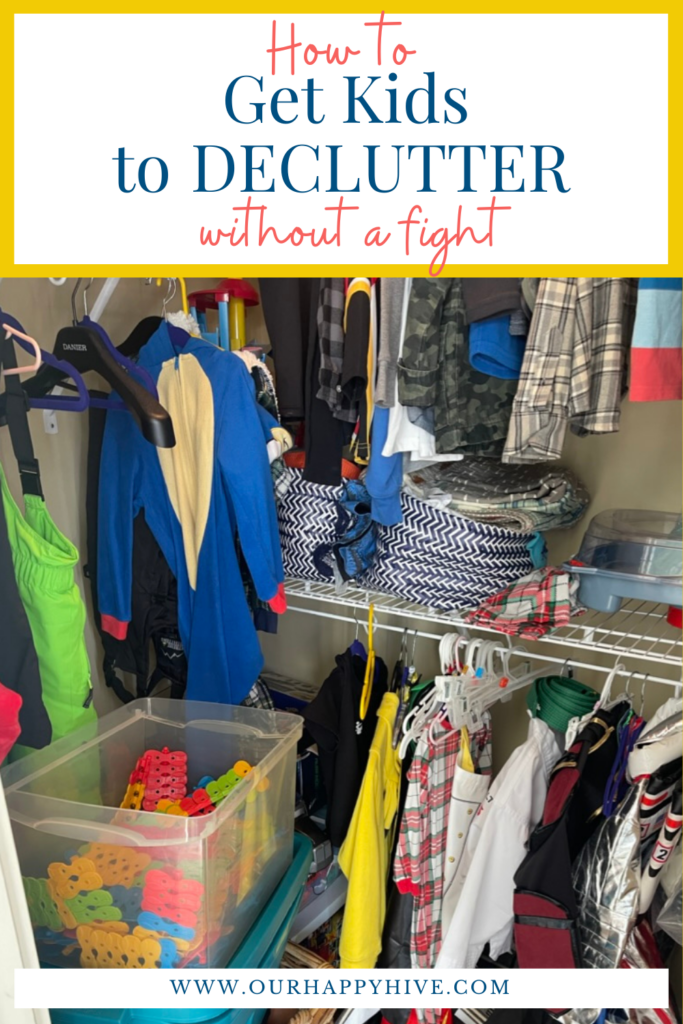
You see a pile of stuff that needs to go. They see their entire world being threatened. You push a little. They dig in harder. And before long, you’ve spent more energy managing emotions than actually making any progress on the closet.
Sound familiar?
Here’s the thing: the battle is almost never really about the stuff. It’s about motivation. When kids have no reason that matters to them, every decluttering session feels like a loss. But when they do? Everything shifts.
This past spring break, I tackled a few organizing projects that had been sitting on my list for way too long, and I watched this play out three different ways with my own kids. None of them involved convincing, bribing, or wearing anyone down. Each one came down to finding the right angle for that particular child, that particular moment.
Here’s what I learned.
Why Kids Resist Decluttering in the First Place
Before we talk strategy, it helps to understand what’s actually going on when kids refuse to let go of things.
It’s usually not stubbornness for the sake of it. Kids hold onto things because those things feel like theirs — part of their identity, their memories, their sense of control in a world where adults make most of the decisions. When we walk in ready to purge, they feel that immediately.
The good news is that resistance almost always softens when kids have a clear vision for what the space could become, or a reason that makes the work feel worth it. Your job isn’t to convince them to care about a cleaner room. Your job is to find the angle that makes them want to do it.
These three strategies are how that actually played out at our house.
Strategy 1: Stop Asking “Should We Get Rid of This?” and Ask This Instead
My son’s closet had been a source of low-grade dread for years. Things were piled, shoved, and crammed in every direction, to the point where I could barely get through the door. And right in the middle of it all, taking up an entire shelf, was his rock collection.
Not just a few keepsakes. We’re talking geodes, minerals, seashells, gems, and every smooth stone he’d ever picked up on a mountain hike. Some were genuinely interesting. Some were… just rocks.
But they mattered to him. And I knew going in that “let’s just get rid of most of these” wasn’t going to fly.
So I started the way I always do: with the easy decisions first.
Trash. Outgrown clothes. The ten Halloween costumes we’d saved for dress-up play that nobody had touched in years. We moved through those quickly, and I noticed something I didn’t expect. Things that would’ve been hard for him to part with a few years ago were suddenly no big deal. He’d simply grown past them.
If you’ve been putting off a decluttering project because you tried before and it didn’t work, take heart. Sometimes waiting actually helps.
Once the easy decisions were handled, we were left with the rocks.
Instead of asking “how do we reduce this?” I tried a different question: “How could this work better?”
That shift changed everything. I headed to the dollar store and found clear plastic containers with divided compartments inside, the kind meant for craft supplies. I grabbed a few: one for minerals, one for seashells, one for gems and colored stones. Then I sat down with my son and we started sorting.
That’s when he leaned in.
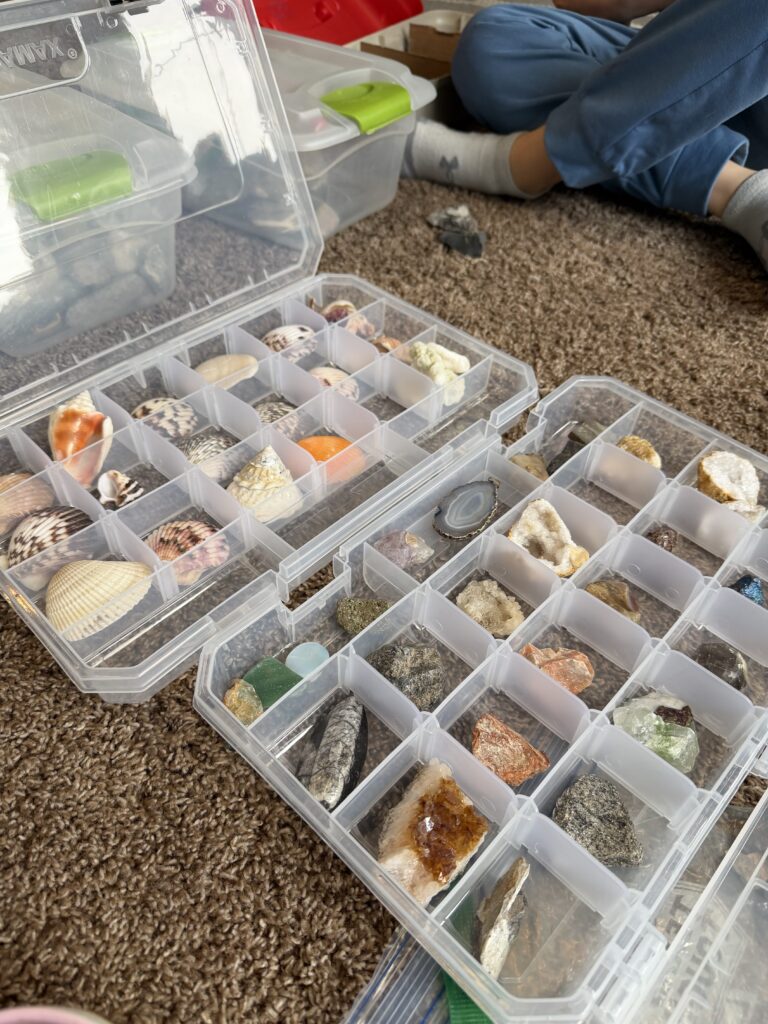
Once he saw his collection being organized rather than eliminated, he got engaged. He started grouping things by type, then arranging by color. He was proud of it. And because the containers had lids, they stacked, meaning the same collection now took up one third of the space it used to.
Same stuff. Completely different result.
The lesson here: when kids are holding onto something that matters to them, the question isn’t always “does this go?” Sometimes it’s “how do we make this work better?” That one reframe can turn a standoff into a project.
Strategy 2: Give Them a Vision Worth Working Toward
My daughter had been asking for a vanity since fall. My answer kept being some version of “we need to make space first,” but nothing really happened. We were both stuck.
Then she visited a friend’s house and saw their setup.
She came home with a picture in her mind of what her room could become. That weekend, without me asking twice, she started clearing out her room on her own. Stuffed animals she’d held onto for years? Gone, without a fight. Decisions she’d been avoiding for months? Made, one after another.
It wasn’t a battle. It wasn’t a negotiation. She could see where she was headed, and the work stopped feeling like a loss and started feeling like progress toward something she actually wanted.
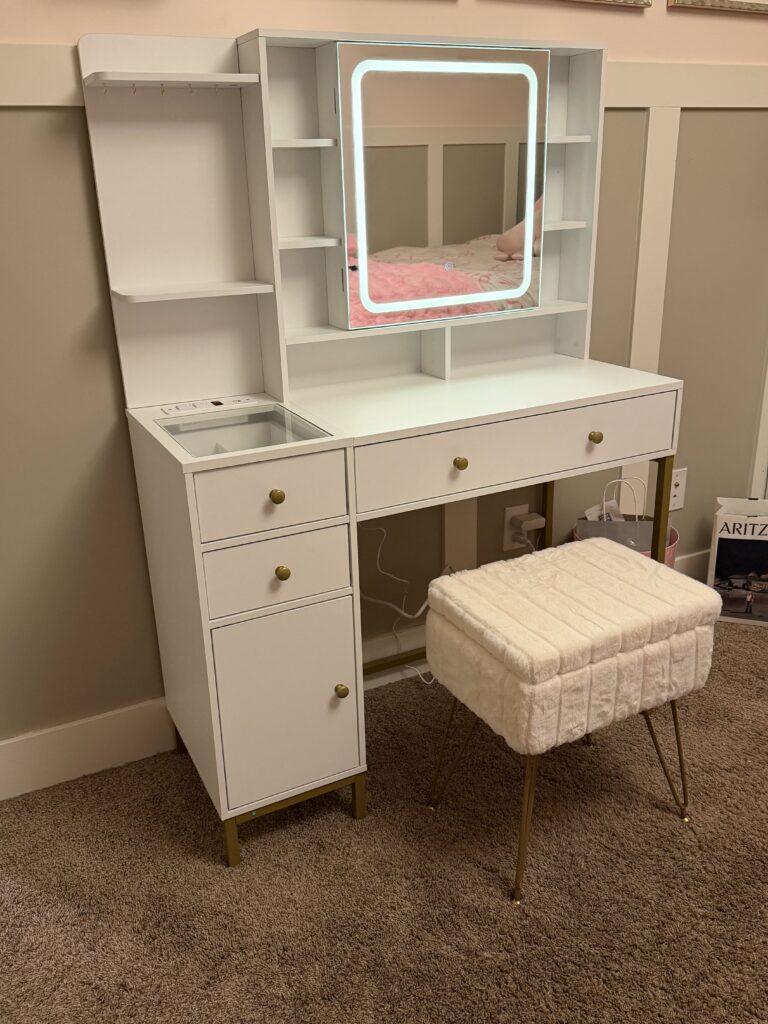
This is one of the most underused strategies for getting kids to declutter without a fight: give them something to work toward, not just something to get rid of. It can be as simple as a new organizational setup, a rearranged room layout, or even just a clear open surface where the clutter used to be.
Ask your child: “What would you love this space to look like?” Then let that vision do the motivating for you.
Strategy 3: Find the Reward That Actually Matters to Them
Then there were the Legos.
If you have kids, you know the scene. Bins of sets that haven’t been touched in years, taking up valuable real estate in a closet or playroom. Getting kids to sort through Legos, let alone part with any, can feel impossible.
Until my kids found out that a local store buys back Lego sets.
A friend’s brother had made $70 doing it. That was all it took. Suddenly, those dusty bins felt interesting again. My kids started sorting through sets on their own, pulling pieces together, organizing by set. No reminders from me. No pushing. Just genuine, self-directed motivation, because now there was a reward attached that actually meant something to them.
The reward doesn’t have to be money. For some kids it’s choosing what to do with the cleared space. For others it’s a small treat at the end of a session, or the simple satisfaction of a real before and after. The key is that the reward matters to them, not just to you.
Before your next decluttering session, ask yourself: what would make this feel worth it for my child? Start there.
The Real Reason It Feels Like a Fight
Looking back at all three situations, the common thread is pretty clear.
There was no fight when there was a reason that mattered. My son leaned in when his collection was being honored, not eliminated. My daughter cleared her own room when she had a vision she was excited about. My kids sorted Legos with zero prompting when there was something in it for them.
The resistance we run into with our kids, and honestly with ourselves too, is almost never laziness. It’s the absence of a compelling enough reason to do the hard thing.
When you find that reason, you don’t have to push. They’ll pull.
Your Tiny Task Checklist: Before Your Next Decluttering Session
Before you ask your child to go through a single item, take two minutes to run through this:
- What does my child care about most in this space? Know what matters to them before deciding what needs to go.
- Is there something that could be reorganized instead of removed? Sometimes a better system solves the problem without the battle.
- Can I give them a vision to work toward? A photo, a plan, or even just a conversation about what the space could look like on the other side.
- What reward would actually motivate them? Think from their perspective, not yours.
- Can I start with the easy decisions and let momentum build? Let them have a few wins before getting to the hard stuff.
You don’t have to solve everything in one session. Pick one thing on this list and start there. That’s enough to change the whole tone of how it goes.
What’s a space in your home that’s been hard to tackle because of the kids? Tell me about it in the comments. I’d love to help you think through the right angle for your family.